SunDoseTanning9 min read
Base tan myth: does a tan protect you from sunburn?
A base tan gives roughly SPF 3 or less, and a tan is a sign of skin damage. What a tan is, why sunbeds don't help and what protects you on a sunny trip.
No. A base tan does not protect you from sunburn in any useful way. The Skin Cancer Foundation puts a tan's protection at roughly SPF 3 or less, and Cancer Research UK calls a tan a sign of skin damage. Shade, clothing and a broad-spectrum sunscreen of SPF 30 or higher protect you far better.
Below: what a tan actually is, how it compares with sunscreen, why sunbeds don't help, and what to do before a sunny trip instead. At the end, we show where SunDose fits. This is general information, not medical advice.
What is a base tan, and why do people get one?
A base tan is a tan built up on purpose, outdoors or on a sunbed, in the weeks before a holiday. The idea is that darker skin will burn less once you reach somewhere sunnier.
In 2026, an American Academy of Dermatology (AAD) survey of 1,132 US adults found that 19 percent believe a base tan can prevent sunburn or reduce cancer risk. More than half believe at least one tanning myth, and 29 percent think tanning is safe if you don't burn. The AAD's May 2026 survey release also estimates that nearly 60 million American adults got a suntan on purpose in 2025.
So if you've planned a few sessions before your flight, you're in large company. But does it work?
Does a base tan protect against sunburn?
Barely. A base tan offers very little protection against sunburn. The Skin Cancer Foundation's tanning page, updated in October 2026, says a tan provides only minimal and inconsistent protection, equivalent to roughly SPF 3 or less. In July 2026, Cancer Research UK's review Debunking the biggest myths about sun safety gave the same estimate: some studies put tanned skin at around SPF 3, far lower than the SPF you need. A 2014 CDC poster, A base tan is not a safe tan, lists about SPF 3 or less and says it does little to protect you from future UV exposure. Compare that with the American Academy of Dermatology's sunscreen advice: a broad-spectrum, water-resistant sunscreen of SPF 30 or higher, which it says blocks 97 percent of the sun's UVB rays. The FDA's page on the risks of tanning is blunt: getting a tan will not protect your skin from sunburn or other skin damage.
| What matters | A tan | Broad-spectrum sunscreen, SPF 30 or higher |
|---|---|---|
| Protection | Roughly SPF 3 or less (Skin Cancer Foundation) | Blocks 97 percent of UVB rays (AAD) |
| Reliability | Minimal and inconsistent (Skin Cancer Foundation) | The SPF on the label indicates its level of sunburn protection (FDA) |
| How you get it | UV exposure that damages skin cells | Applied to your skin |
| Upkeep | Keeping it means more UV exposure | Reapply about every two hours, and after swimming or sweating (AAD) |
Even naturally dark skin isn't a full shield: a Skin Cancer Foundation piece from August 2026 notes that the darkest skin tone only provides the equivalent of SPF 13. For what the numbers on a bottle mean, see SPF 30 vs SPF 50.
What is a tan, biologically?
A tan is your skin's response to injury. The Skin Cancer Foundation explains that UV radiation from the sun or tanning beds causes genetic damage to cells in the outermost layer of your skin. The skin then produces melanin, the pigment that gives skin its color, to try to prevent further injury. That darkening is what we call a tan.
- UV reaches your skin, from the sun or from a sunbed.
- It damages the DNA in cells in the outer layer of skin.
- Your skin makes more melanin to try to prevent more injury.
- The skin darkens. That is the tan, and the damage behind it builds up with every tan.
Cancer Research UK agrees: a tan is a sign that your skin is trying to protect itself from the damage the sun is doing. That damage can start before sunburn and builds up over time, raising skin cancer risk, so there's no such thing as safe UV tanning.
Tanning easily doesn't exempt you. The Skin Cancer Foundation says that even if your skin type is not fair, tanning causes DNA injury that can lead to premature aging and skin cancer. Our guide to Fitzpatrick skin types explains how the six types burn and tan.
Is a tanning bed a safer way to build a base?
No. Cancer Research UK says sunbeds will not help you build a tolerance to the sun before you go on holiday, and that any level of sunbed use increases the risk of skin cancer, whatever your skin tone. The Skin Cancer Foundation adds that tanning beds don't offer a safe alternative to sunlight.
IARC, the World Health Organization's cancer agency, classified UV-emitting tanning devices as carcinogenic to humans in 2009. A 2017 WHO news release says sunbeds increase the risk of melanoma and non-melanoma skin cancer, and that melanoma risk rises with younger age at first use and greater lifetime use. The AAD's skin cancer statistics, updated in March 2026, state that women younger than 30 are six times more likely to develop melanoma if they tan indoors.
What about vitamin D? Cancer Research UK says there is no need to use sunbeds to get enough. The Skin Cancer Foundation explains why tanning is a poor route anyway: UVB leads to the production of vitamin D, while tanning is mostly caused by UVA rays. Our UVA vs UVB guide covers the difference, and how much sun you need for vitamin D covers the rest.
Why do so many people still believe it?
Partly because there's a grain of truth in it. A tan does block a little UV. The catch is the size: around SPF 3, against the SPF 30 dermatologists recommend. And if you don't see a burn, it's easy to assume nothing happened, yet damage can start before sunburn.
Looks play a part too. In the AAD's 2026 survey, 55 percent of adults said tanned skin looks healthier, and nearly half reported encountering sunscreen misinformation online.
The newest version even has a name: tanmaxxing. An August 2026 piece published by the Skin Cancer Foundation describes it as intentionally seeking a high UV index, sometimes swapping sunscreen for tanning oils or tanning beds, to get the darkest tan possible. Yet, as the piece points out, the UV index was created to show when to be extra careful with sun protection.
None of this makes anyone foolish for trusting a base tan. It's an old idea that sounds reasonable; it just doesn't hold up.
What actually protects your skin before a sunny trip?
Skip the pre-trip tanning and pack a plan instead. These steps come from AAD and Cancer Research UK guidance:
- Check the UV index, not the temperature. Cancer Research UK notes that UV levels above 9 are very rare in the UK, but regularly reach 10 in the Mediterranean and 16 around the equator. Our guide to how UV changes hour by hour helps you read the forecast.
- Use enough sunscreen. The AAD recommends broad-spectrum, water-resistant SPF 30 or higher: about 1 ounce, roughly a shot glass, for most adults. Reapply about every two hours, and after swimming or sweating.
- Seek shade. The AAD's rule of thumb: if your shadow is shorter than you are, seek shade.
- Cover up. A lightweight long-sleeved shirt, pants, a wide-brimmed hat and sunglasses with UV protection.
- Want the look? Use a bottle. Cancer Research UK suggests fake tan or spray tan as safer ways to look tanned, but a fake tan won't protect you from UV.
How can SunDose help on a sunny trip?
SunDose won't make any tan safe, and we don't suggest using it to build a base. What it can do is support the protection plan above.
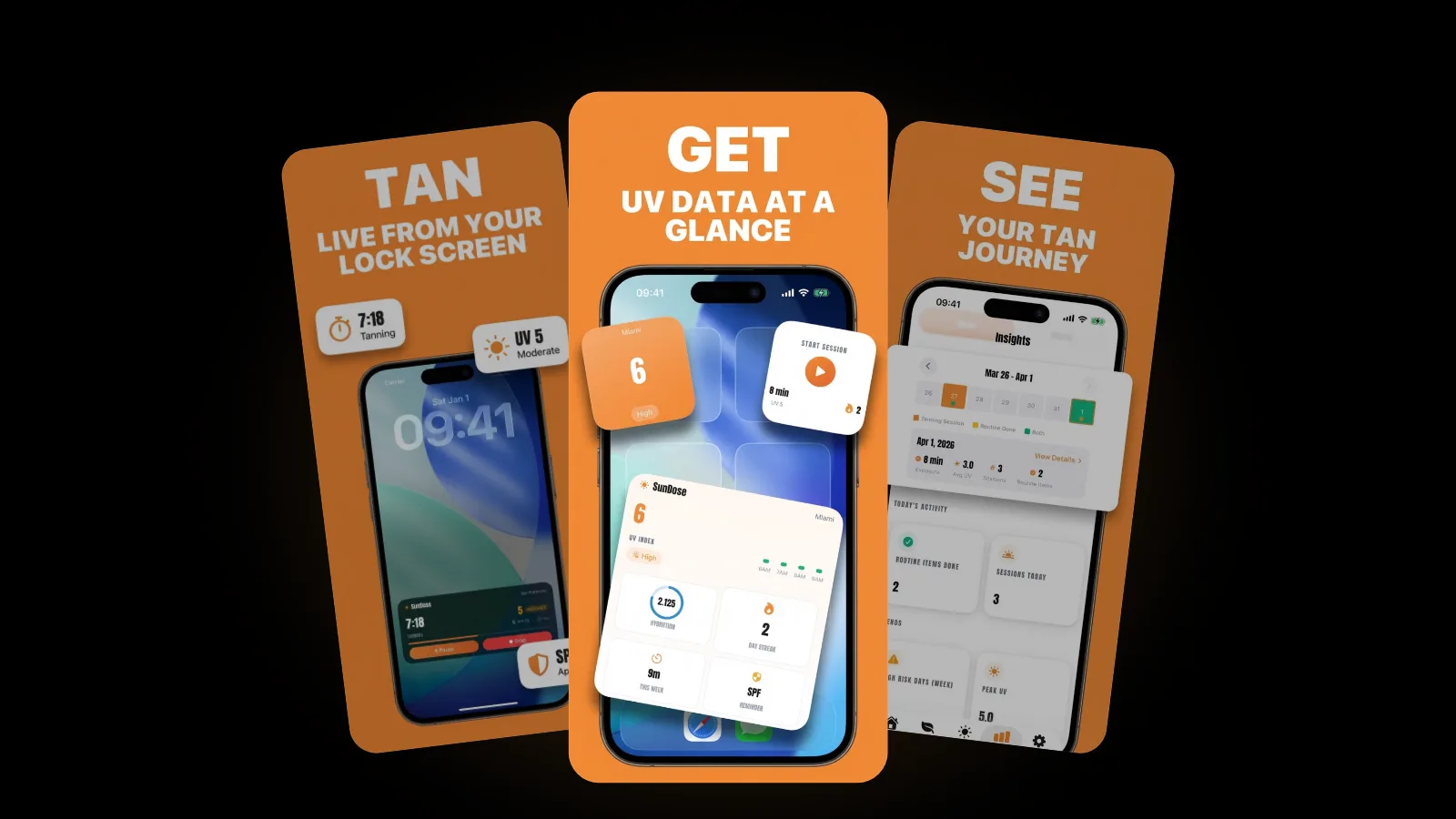
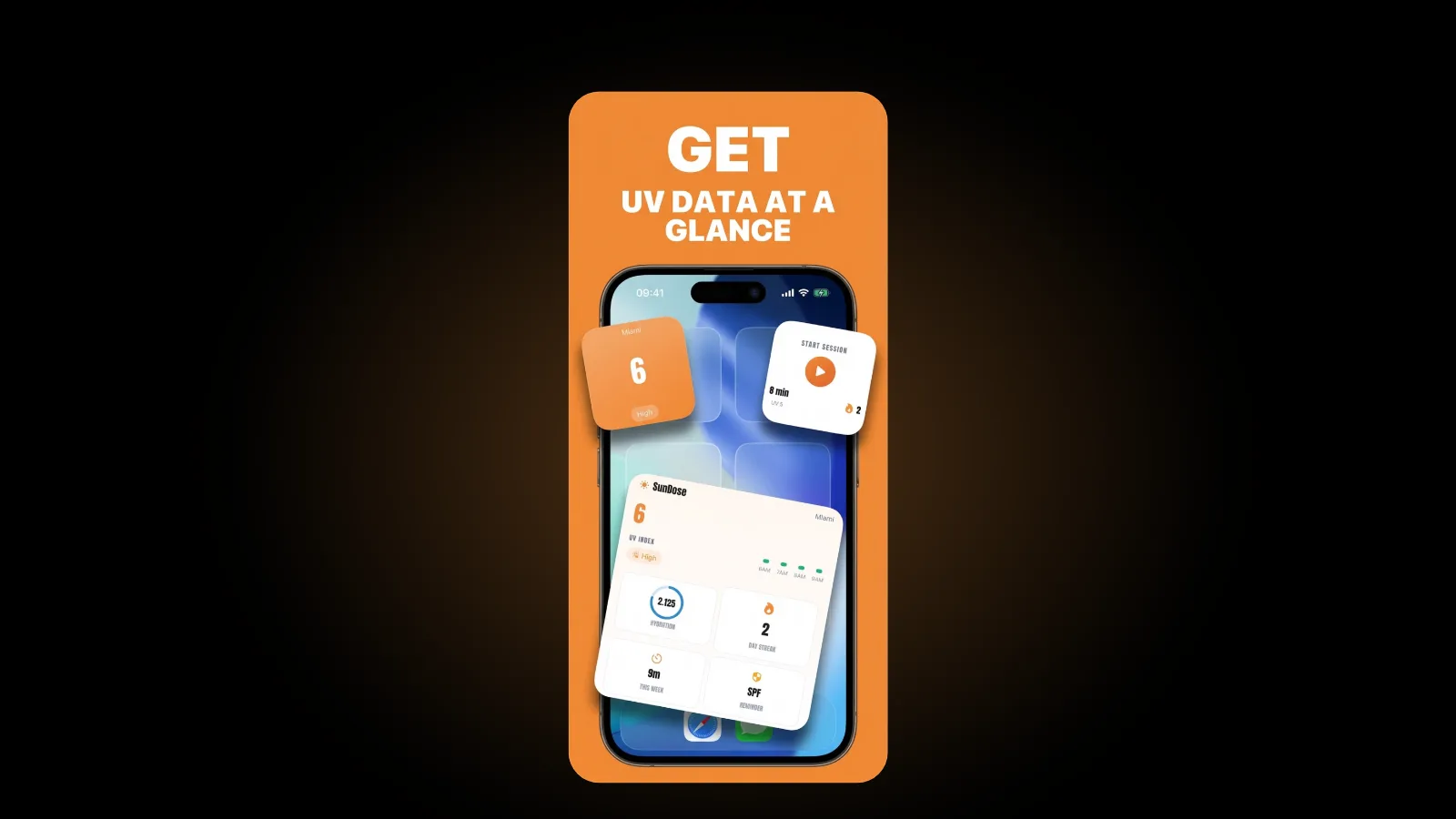
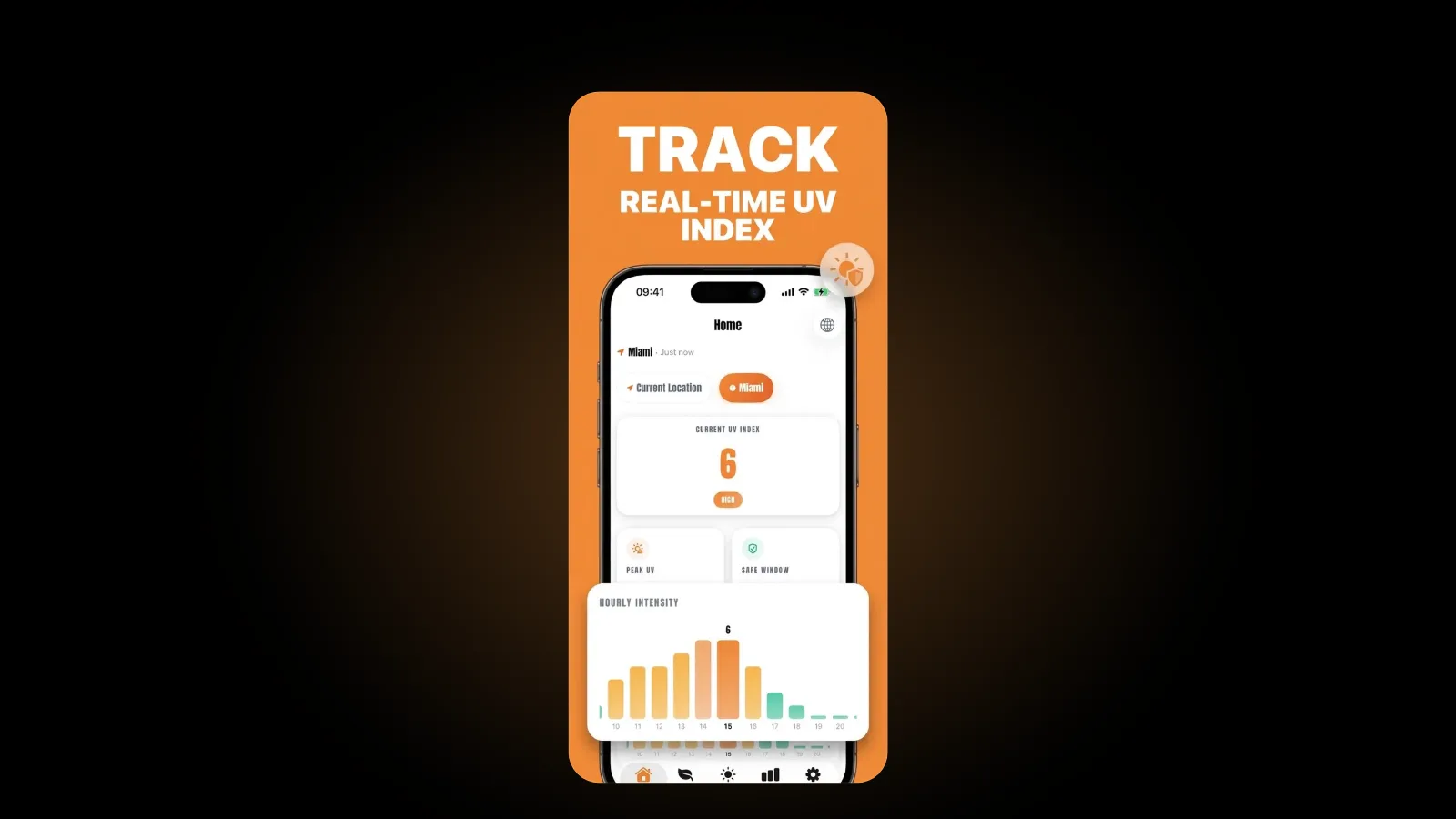
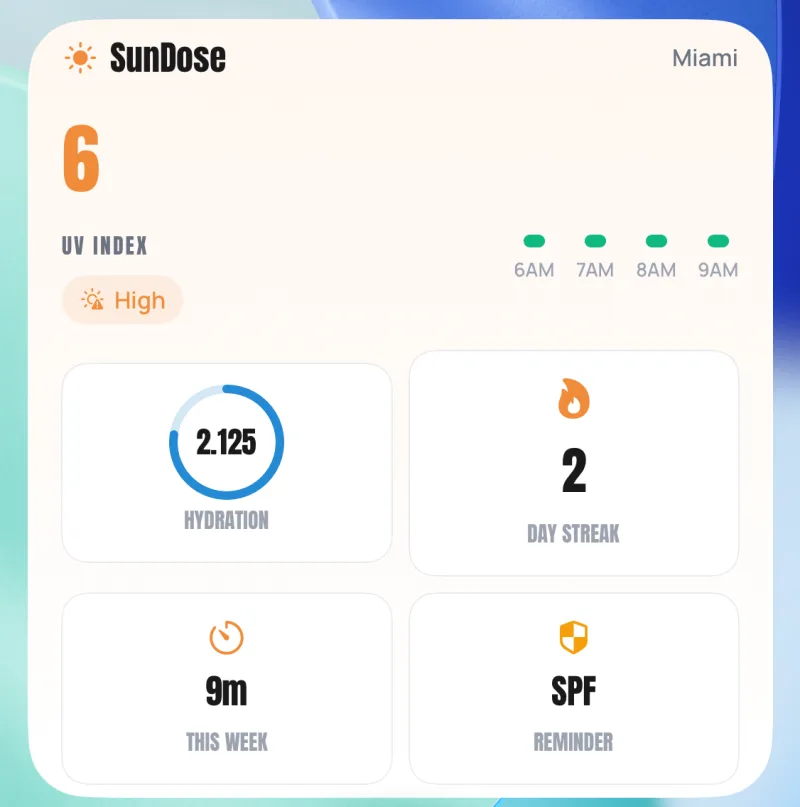
- Plan around the live UV forecast. SunDose shows the live UV index for your location, with hourly and weekly forecasts from Apple WeatherKit, so you can see when the peak falls.
- Start each day with protection. Home Screen widgets show the UV index and an SPF reminder at a glance.
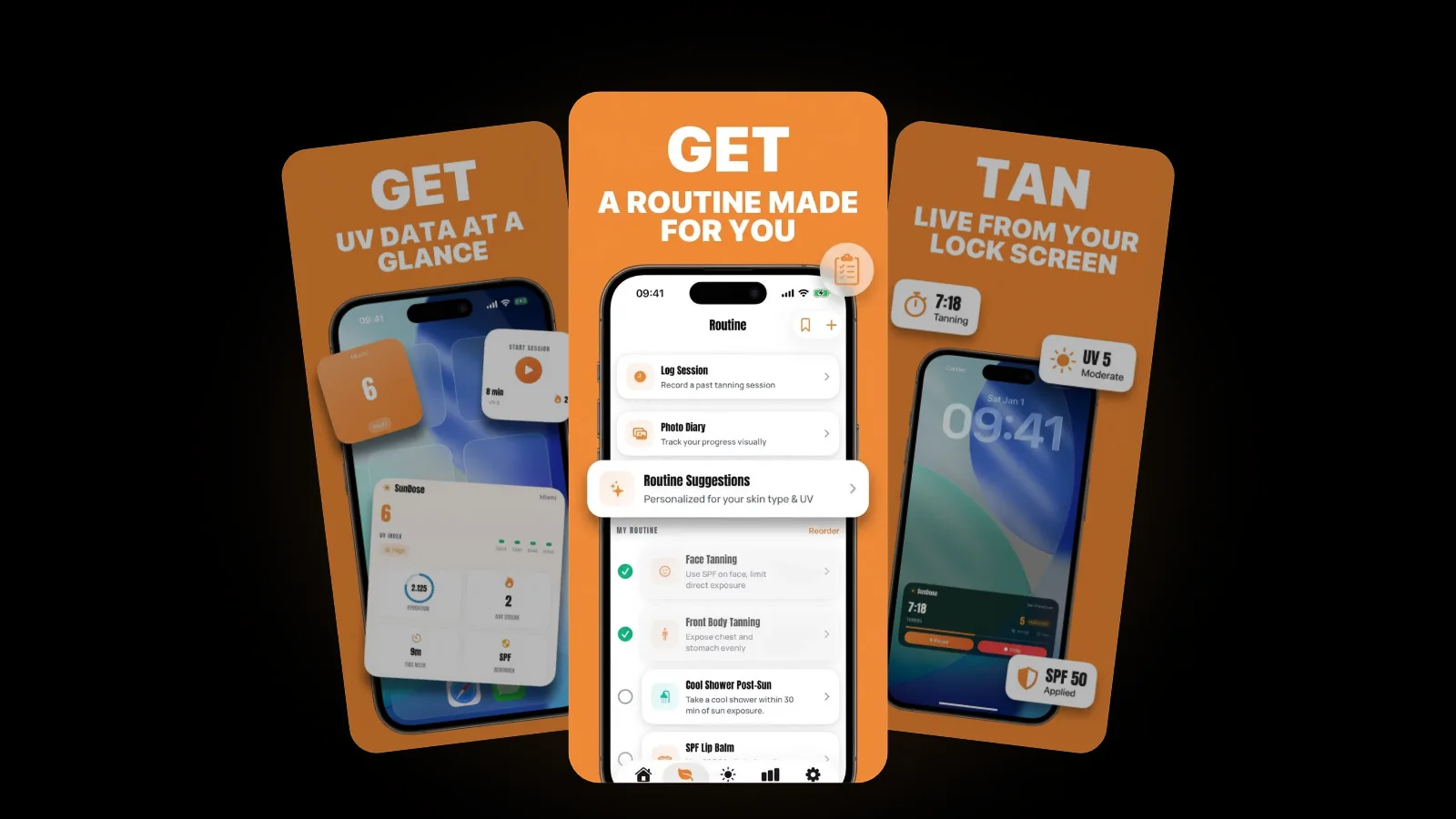
- Get reapply prompts while you're outside. The session timer suggests a length from 1 to 180 minutes, based on your skin type, the current UV and the SPF you say you applied. Reapply prompts run on the session clock, with haptic and notification alerts.
- Flag sensitivities. Flag retinoids, exfoliating acids, isotretinoin or tetracycline antibiotics such as doxycycline, and SunDose shortens its suggestions. See medications that cause sun sensitivity.
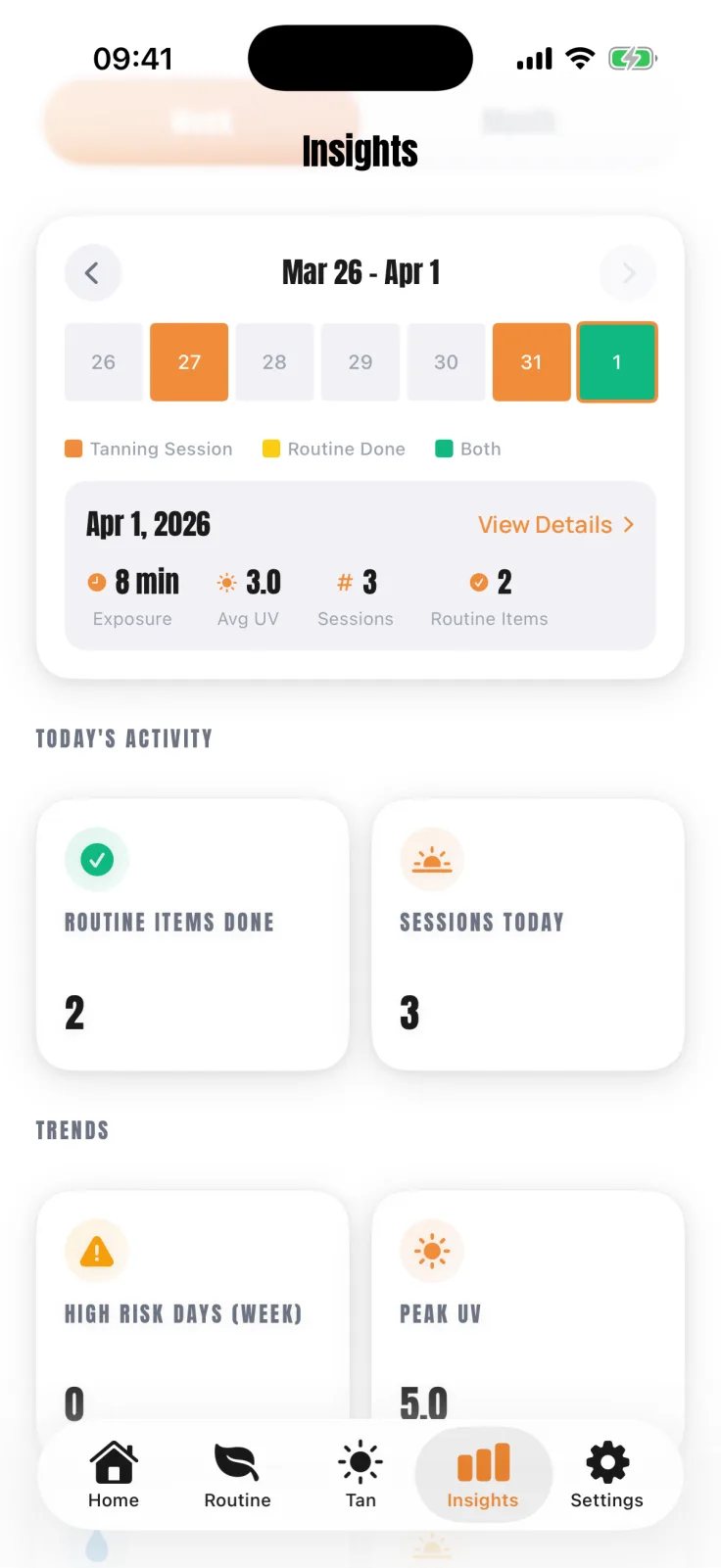
- Look back at your week. Insights show total minutes, average UV, higher-risk days and a 30-day calendar.
SunDose records the reported UV and the time you log; it is not a dosimeter. Your data stays on your device, with no ad tracking. It needs an iPhone with iOS 26 or later.
FAQ
Is a base tan healthy?
No. The Skin Cancer Foundation says there is no such thing as a safe or healthy tan, and the AAD calls any tan a sign of UV damage. A tan forms because UV has damaged skin cells, and that damage builds up from the very first tan.
Does a tanning bed before a vacation prevent sunburn?
No. Cancer Research UK says sunbeds will not help you build a tolerance to the sun before a holiday, and that any level of sunbed use increases skin cancer risk. A tan from either source offers only about SPF 3.
Does fake tan protect you from the sun?
No. Cancer Research UK suggests fake tan or spray tan as safer ways to look tanned, but says a fake tan won't protect you from UV radiation. You still need shade, clothing and a broad-spectrum sunscreen of SPF 30 or higher.
What is tanmaxxing?
A social media trend. A piece published by the Skin Cancer Foundation in 2026 describes it as intentionally seeking a high UV index, sometimes swapping sunscreen for tanning oils or tanning beds, to get the darkest tan possible. It warns that sun damage is cumulative, starting with your very first tan or burn.
Get started
SunDose is free to download on the App Store, with optional premium tiers; the UV index, hourly forecast and session timer work without a subscription. SunDose is a wellness app, not a medical device. See everything it does on the SunDose page or read more SunDose articles.